I would like to focus this paper on the work of some artists from the eighteen hundred up to nowadays that have represented the spiritual throughout the process of creating art. The meaning that they wanted to express was similar through time, but the way to express it changed with the development of technology, modernity and new medias as well as the shift that human kind is taking from materialist to spiritualism as part as our evolution as a species.
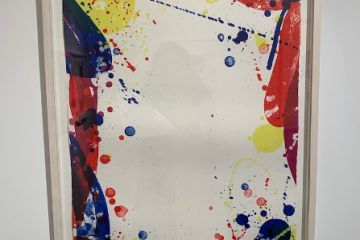
People nowadays have made a shift from being religious to becoming spiritual and the unknown is becoming more known to our collective unconsciousness. As a consequence, more people are trying to describe, thorough art, the invisible world. One way of doing this is analyzing the whole and the part. We can approach each part of the whole or have a closer look and see that we can find many universes inside a part. George O’Keeffe, for example, painted flowers with such incredible intake that each flower became a universe on the canvas. Vija Celmis paints skies and constellations with an incredible amount of detail that the universe can become bigger and smaller at the same time. Her canvas goes beyond time and space. Natvar Bhavsar uses new tools to apply color in an abstract way and the results are incredible paintings that the viewer can enter inside it. Barbara Takenaga works with round shapes in a meticulous and repetitive way that the part is inside the whole and the whole is made from small parts. This way the viewer can zoom in and zoom out from the art to understand better and to get the feeling that the artist is transmitting.
Thinking on some particular artists that inspired me in this journey.
Barbara Takenaga, Hiroshi Senju, Natvar Bhavsar, Vija Celmins, Makoto Fujimuro, Hilma af Klint, Georgia O’keeffe and Loie Hallowel
New York also just had this year an exhibition at the Guggenheim from Hilma af Klint : Paintings for the Future and that amazing woman had channelled, from a non-incarnate spirit, several paints that represent the spiritual world. She created her own way of describing it by creating a universe of shapes and colors that reflects her concept of the spiritual. She created her own diagram of images and told us a story about what message she was trying to pass to us. Around the end of 19th century, she also became deeply involved in spiritualism and Theosophy. These modes of spiritual engagement were widely popular across Europe and the United States—especially in literary and artistic circles—as people sought to reconcile long-held religious beliefs with scientific advances and a new awareness of the global plurality of religions.
Loie Hallowel is an artist that lavished considerable attention on the flat side of a circle sliced in half which she painted with a sponge to produce tiny, gleaming peaks those shapes appear in each of the paintings on display. She uses visible brushstrokes, sometimes loose and sometimes tight, that arise from the circular motion Hollowell uses to blend paint. The shapes can be orbs and concentric circles with 3-D high-density foam pieces displaced in a symmetrical composition on the canvas. She focuses on texture, composition, space, color, the blend of light to dark and to finish a work, to her, is to achieve an enlightened state, a transcendent feeing. The composition is very symmetrical and she explained that the reason for this is because the body is symmetrical and she chooses to make the canvas in human size proportion. The universe can be the body, the shapes or each circle that she creates to represent it. She feels the connecting between her art and spirituality through the process of making the painting and not in the moment of choosing colors or shapes. Color and light is in the central element. Spirituality is in the practice of making art.
Vija Celmins is a 78 year old woman who is a work alcoholic and she produced a beautiful body of work. The subject matter she depicts is the sky, oceans ( waves ), deserts, night skies, galaxies, constellations, spiderwebs, antique writing slates. She paints in a photorealist way, using lots of details with extraordinary skill using a wide range of media. She works doing paintings, sculpture, drawings, and prints.
They can take years to make and now they sell for several millions of dollars. She is known to do a redescription of those subject matters and her work is aligned with pop, minimalist and conceptual art at the same time. Her collection range is in hues of black and white but even so creates intimacy with the viewer that goes from a close up to a more distance approach to get the whole image.
Each piece can take years to make despite their often small size and seem so realistic as to often be mistaken for photographs. She does a
“redescription,” of the motifs she is representing is like a little universe in each own subject matter.
Her work is aligned with Pop, Minimal and Conceptual Art — and even Photo Realism.
Makoto Fujimuro with his Japanese style of painting and creation of a slow art movement where he wants to capture the silence and the beauty from color and composition. He prepares the ink using a particular Japanese style using powder pigments that originate from stones. Then he creates 80 to 100 layers before he starts to paint to express contemporary art. He is showing us how time and space are relative.
Most of the artists can be a medium from which the invisible world can speak through and make manifest what wasn’t manifest before. The artist is just a part of that transformation process and a way to represent the invisible world in a manifest world through someone’s hands and through abstract art, people are achieving beautiful examples.
Bibliography
https://www.metmuseum.org/exhibitions/listings/2019/vija-celmins
https://shop.thejewishmuseum.org/georgia-okeeffe/4094732972472117733/product
https://www.makotofujimura.com/